Shipping to the U.S.? Please read the new U.S. regulations before placing your order.


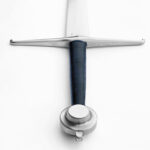
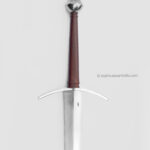
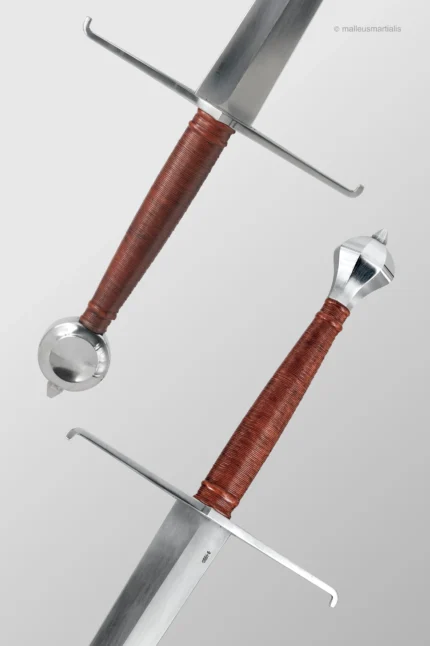
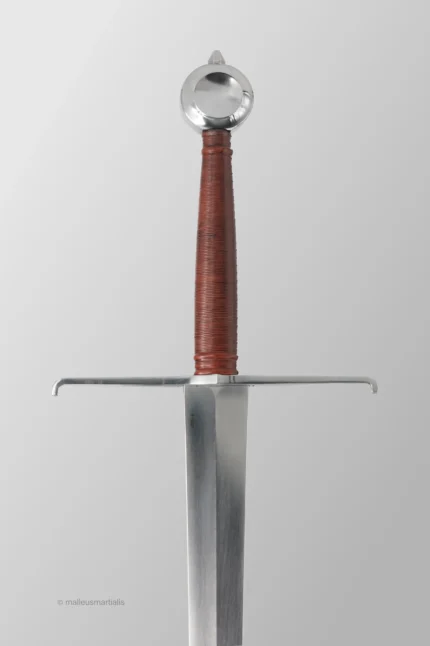
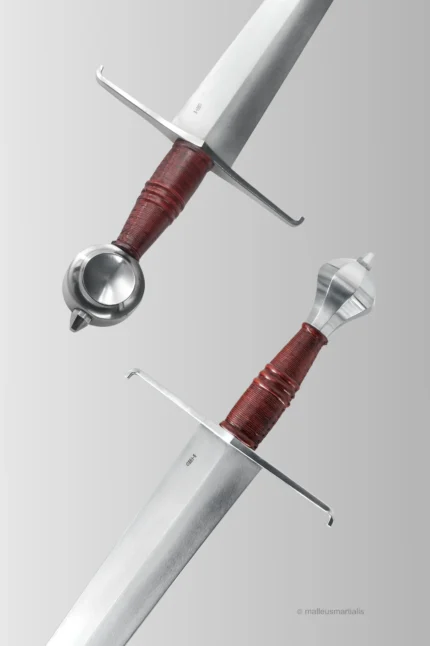
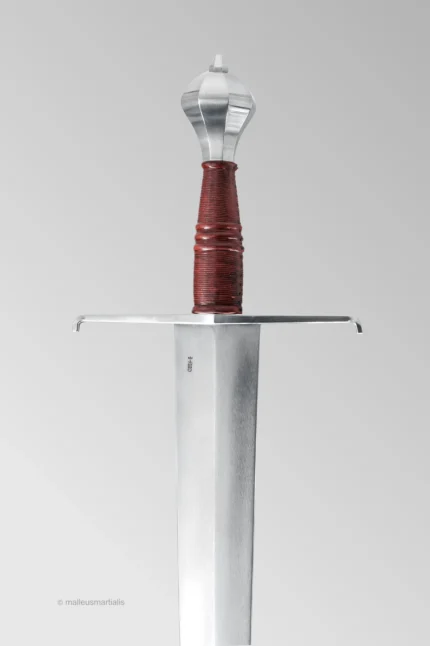
The Lupa Longsword draws inspiration from the iconic 15th century artifact housed in the Museo delle Armi Luigi Marzoli in Brescia, Italy, and it is more commonly known as the Brescia Spadona. Featuring a spiked pommel, robust hexagonal-profile crossguard, and an imposing fullered blade with an acute point, its design reflects the evolution toward thrust-oriented swords capable of piercing plate armor. In the original finding, the fuller bears the mark of Passau, the most prolific center of blade manufacture in Germany after Solingen. The mark is inlaid in gold, showing a simplified outline of a running wolf, the city’s coat of arms. While our version omits the inlay for practicality, it faithfully preserves the essence and martial elegance of the original design.
The sword’s anatomy reflects the transition toward thrust-oriented designs capable of piercing plate armor. Type XVIa blades, following Oakeshott classification, were typified by their strong profile taper, diamond cross-section, and broad forte, and were favored for their versatility in both cutting and thrusting during the height of chivalric combat. La Lupa preserves this legacy, translating the archetypal aesthetics and martial purpose into a high-performing training sword.
Our design process included a 8-hour examination of the original artifact, a privilege extended to us by the museum’s curator, Dr. Marco Merlo. The inspection revealed fascinating details: different traces of corrosion between the hilt and the blade, a slightly enlarged guard hole, and signs of 19th-century restoration work, which abraded the superficial layer of steel on the blade, sadly resulting in the rounding of the fuller and partial removal of the golden inlay. Despite these alterations, and the legitimate doubt that it could be a later riassembly of different swords’parts, the artifact remains a testament to the skill and artistry of European Reinassance swordmaking.
FEATURES:
- Individually handcrafted: No templates, ensuring every future project inspired to this is uniquely crafted and possess its own character.
- Agile and robust: Around 1.7 kilograms, it is ideal for practicing Fiore dei Liberi’s techniques with measured control, suited for technical drills and precise execution, both unarmored (sine armis) and in armor (in armis).
- Heat-treated crossguard and blade: Ensures durability and resilience, making it fully functional.
- Fullered Diamond-section blade: Offers rigidity, control, and thrusting accuracy.
- Robust hexagonal crossguard: Faithfully crafted for historical accuracy and enhanced durability.
- Blunt edges and thickened tip: Prioritizes safety for technical controlled demonstrations.
- Thinner edge (1.5–1 mm): Offers closer adherence to historical dynamics.
- Collector’s quality: A fully functional and authentic piece, ideal for advanced practitioners of historical fencing, demanding reenactors, collectors and display.
- As a museum-grade sword, the Lupa Longsword bridges the worlds of historical research and technical martial application, ideal for demanding reenactors, advanced historical fencers, film productions, and collectors seeking luxury craftsmanship.
As a museum-grade sword, the Lupa Longsword bridges the worlds of historical research and technical martial application, ideal for demanding reenactors, advanced historical fencers, film productions, and collectors seeking premium craftsmanship.